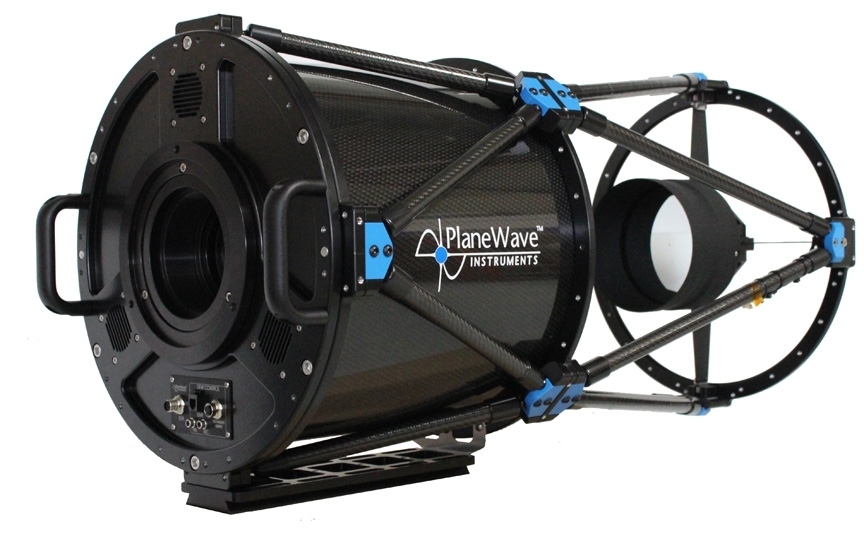
PlaneWave CDK14 Telescope
Price as Configured: $18,500.00
The PlaneWave CDK14 delivers observatory-class imaging in a 48-pound package — pinpoint stars across a 70mm flat field with fused silica optics that hold focus all night. Deep Space Products provides expert guidance on mount selection, imaging train configuration, and complete system integration for both backyard observatories and remote installations. The CDK14 is compatible with DSP Remote hosting under Bortle 1 skies in New Mexico. Contact us to discuss your imaging goals and build the right system.

Tell us what you're looking for, and we’ll point you in the right direction. Email Us.
PlaneWave CDK14 — Observatory-Class Imaging Without Observatory-Class Complexity
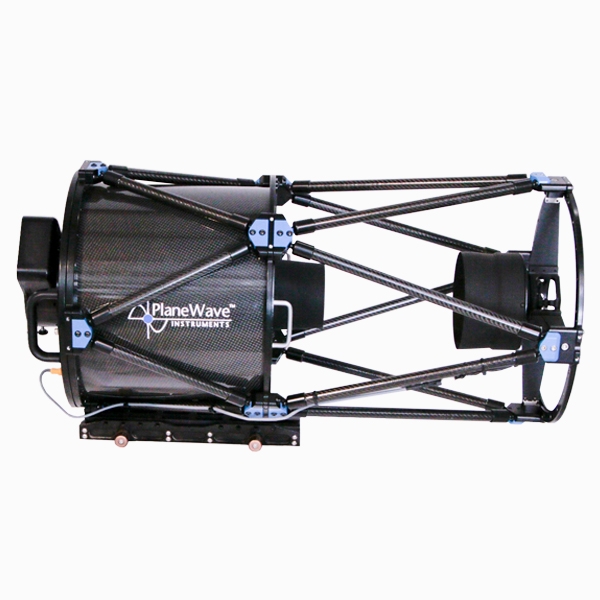
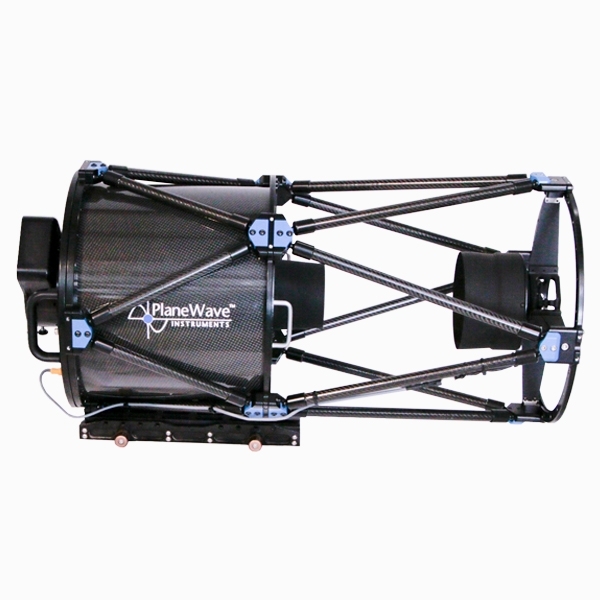
The PlaneWave CDK14, available from Deep Space Products with full system integration support, is a 14-inch f/7.2 Corrected Dall-Kirkham astrograph that delivers diffraction-limited performance across a 70mm flat field — large enough to cover full-frame sensors with pinpoint stars from center to corner. At 48 lbs (22 kg), it sits in a rare category: serious aperture that mid-range mounts can still carry, with optical quality that rivals instruments costing twice as much.
For astrophotographers moving beyond refractors or upgrading from consumer-grade SCTs, the CDK14 represents a significant step up in light-gathering power, resolution, and field correction — without the collimation nightmares or thermal instability that plague many large-aperture designs. The telescope's fused silica mirrors, carbon fiber construction, and fixed primary design mean you spend your nights imaging, not chasing focus or tweaking alignment.
Why the CDK design outperforms traditional Ritchey-Chrétien telescopes
The Ritchey-Chrétien (RC) optical design has dominated professional observatories for decades, but it comes with significant tradeoffs for amateur imagers. While RCs eliminate coma, they still suffer from off-axis astigmatism and field curvature — aberrations that produce elongated stars at the edges of large sensors. Worse, RC collimation is notoriously unforgiving. The hyperbolic secondary mirror must be precisely aligned to the primary's optical axis, and the tolerances are tight enough that many RC owners never achieve the design's theoretical performance.
PlaneWave's CDK design solves these problems elegantly. The spherical secondary mirror has no optical axis to align — it only needs to be centered and spaced correctly, both of which are set at the factory. That leaves tip/tilt adjustment as the only user collimation task, achievable in minutes with basic tools. The corrector lens group near the focal plane eliminates both astigmatism and field curvature, delivering a perfectly flat field with RMS spot sizes under 6 microns at 35mm off-axis. The result: stars that remain pinpoints across your entire sensor, with collimation that stays put night after night.
Fused silica optics and thermal stability
Temperature changes are the enemy of long-exposure imaging. As ambient temperatures drop through the night, most telescope optics expand or contract, shifting focus and degrading image quality. The CDK14's fused silica mirrors have an extremely low thermal expansion coefficient — roughly six times lower than standard glass — so focus shift is minimal even during significant temperature swings.
Users report focusing once after thermal equilibrium (typically an hour after sunset) and holding focus through entire imaging sessions without adjustment. The carbon fiber truss construction reinforces this stability: the entire optical tube assembly contracts less than aluminum-tubed alternatives, and flexible thermal joints at the dovetail prevent mechanical stress from temperature differentials.
Three rear-mounted fans accelerate cool-down by pulling air across the primary mirror, reducing the time to thermal equilibrium and minimizing boundary-layer turbulence that degrades image quality. For humid environments, pre-installed polyimide heater pads on both mirrors connect to PlaneWave's Delta-T controller (sold separately), providing active dew prevention controlled through PWI software.
Specifications that matter for imaging
The CDK14's 356mm (14-inch) aperture and 2563mm focal length yield an f/7.2 system — moderate enough for reasonable exposure times while providing the resolution to capture fine detail in galaxies and planetary nebulae. The 70mm illuminated image circle covers full-frame sensors (43mm diagonal) with room to spare, and vignetting in the extreme corners measures only 10% — easily corrected in processing.
With 282mm (11.09 inches) of back focus from the mounting surface, there's ample room for filter wheels, off-axis guiders, and rotators without running out of focus travel. The telescope ships without a focuser, allowing you to choose the option that best fits your imaging train — PlaneWave's Hedrick focuser, the IRF90 integrated rotating focuser, or third-party options like the Optec Gemini.
For wider field work, PlaneWave's 0.66x reducer converts the CDK14 to an f/4.76 system with a 30mm illuminated field — fast enough for narrowband imaging of large emission nebulae while still delivering excellent star shapes across APS-C and smaller full-frame sensors.
Mount compatibility and system integration
At 48 lbs without accessories, the CDK14 works well on mid-range mounts with 60–80 lb payload capacities when used for imaging (where you want significant headroom above the rated capacity). Popular pairings include:
- 10Micron GM1000HPS EP or GM2000HPS: Premium German equatorial mounts with absolute encoders and sub-arcsecond tracking — ideal for unguided or lightly guided imaging. Deep Space Products is the exclusive certified U.S. service provider for 10Micron.
- PlaneWave L-350: PlaneWave's own direct-drive mount, designed specifically for the CDK14 and CDK12.5. 100 lb payload capacity, zero periodic error, 50°/sec slew speeds.
- Astro-Physics 1100 or 1600: Proven performers for demanding astrophotographers who prioritize mechanical precision.
Deep Space Products can help you select the right mount for your imaging goals, whether you're building a backyard roll-off-roof observatory, a permanent dome installation, or a portable rig for dark-sky star parties.
Who the CDK14 is for
The CDK14 hits a sweet spot for astrophotographers who want serious aperture without the weight, complexity, or cost of larger observatory instruments. It's well-suited for:
- Advanced imagers stepping up from 6–8 inch refractors or SCTs who want more resolution and light-gathering power
- Observatory builders designing home or club installations where the 48 lb OTA weight keeps mount requirements reasonable
- Remote hosting setups where reliability and low maintenance are essential — the CDK14 is compatible with DSP Remote hosting in southwest New Mexico
- Institutions and universities seeking a research-capable instrument with straightforward operation for student use
If you're imaging primarily at focal lengths under 1000mm and don't need the resolution that 14 inches of aperture provides, a high-quality refractor may be simpler. But for deep-sky targets where aperture and resolution matter — small galaxies, planetary nebulae, globular clusters — the CDK14 delivers performance that would have been professional-grade a generation ago.
Talk to Deep Space Products about your CDK14 system
Choosing a telescope is just the first step. The imaging train, mount, automation hardware, and software all need to work together. Deep Space Products has helped hundreds of astrophotographers build systems that perform — from first light to publication-quality images. Whether you're planning a permanent observatory or a transportable setup for dark-sky trips, we can help you configure a CDK14 system that matches your goals and budget.
Contact us for a free consultation. We're happy to discuss mount options, focuser choices, camera compatibility, and how the CDK14 fits into your imaging workflow.
Related Products
 PlaneWave IRF90 - Integrated Rotating FocuserPW-600180 $5,980.00
 PlaneWave Hedrick FocuserPW-200340 $1,325.00