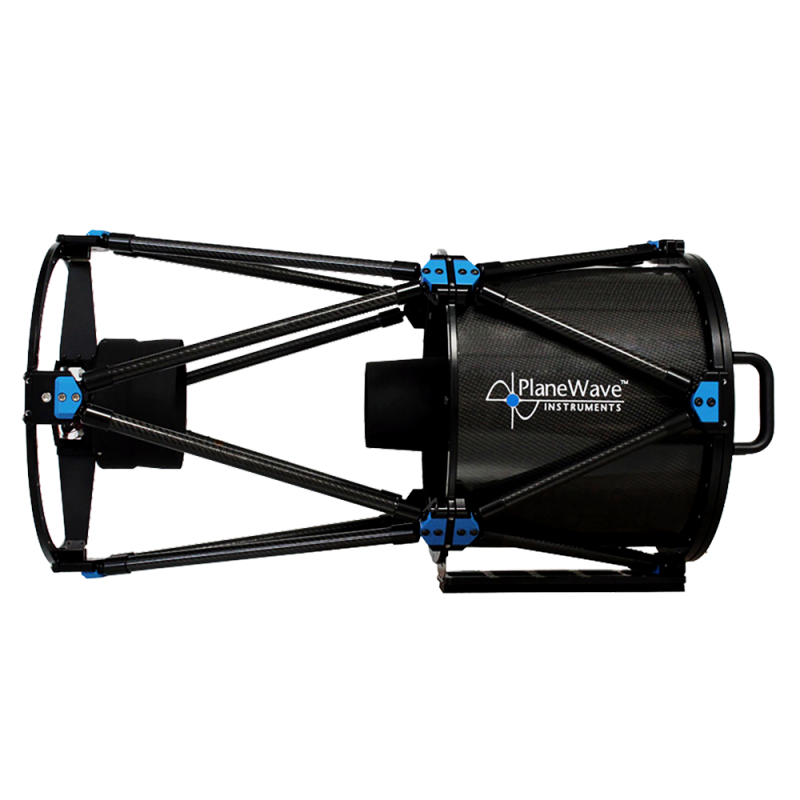
PlaneWave CDK14 S5 Package
Price as Configured: $19,000.00
The PlaneWave CDK14® S-5 Package gives serious astrophotographers and observatory builders a 14-inch Corrected Dall-Kirkham astrograph with pinpoint stars across a 70 mm image circle — and includes PlaneWave's new Series-5 low-profile focuser and controller at a greatly reduced cost. Deep Space Products is an authorized PlaneWave dealer with hands-on observatory integration experience, and the CDK14 pairs perfectly with telescope hosting at DSP Remote, our Bortle 1 facility in southwest New Mexico. Questions? Contact us — we help customers match equipment to their imaging goals.

Tell us what you're looking for, and we’ll point you in the right direction. Email Us.
PlaneWave CDK14 S-5 Package — Observatory-Class Imaging, Ready to Mount
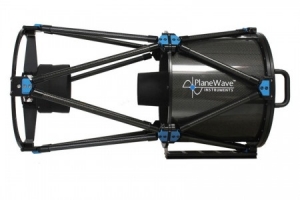
The PlaneWave CDK14® is a 14-inch (356 mm) f/7.2 Corrected Dall-Kirkham astrograph designed for demanding astrophotographers, observatory builders, and research institutions who need diffraction-limited performance across a large sensor. The S-5 Package bundles the CDK14 optical tube with PlaneWave's new Series-5 focuser and controller for an exceptional value, making it the most capable CDK14 configuration available. Deep Space Products is an authorized PlaneWave dealer with direct experience integrating CDK telescopes into permanent and remote observatories.
At 48 lbs (22 kg), the CDK14 is large enough to deliver serious light-gathering power and resolution without requiring a pier-mounted behemoth. Its carbon fiber open-truss construction keeps the optical tube rigid and thermally stable, reaching ambient temperature faster than most solid-tube designs at this aperture. The result is a telescope that's ready to image sooner after dark — and stays in focus throughout the night as temperatures drop.
The CDK optical advantage: flat field, no coma, no astigmatism
The Corrected Dall-Kirkham design is PlaneWave's signature innovation. While a Ritchey-Chrétien telescope addresses off-axis coma, it does nothing to eliminate field curvature or off-axis astigmatism — two problems that become increasingly visible as modern sensors grow larger. The CDK design uses an ellipsoidal primary, a spherical secondary, and a correcting lens group to eliminate all three aberrations simultaneously. The CDK14 delivers 3.1 micron RMS spot sizes at 13 mm off-axis and 6 micron RMS at 35 mm off-axis — smaller than a single pixel on most CMOS sensors, across a 70 mm field diameter.
In practical terms, this means you get pinpoint stars from center to corner on full-frame sensors, with minimal post-processing to address field curvature or corner star shape. Users on Cloudy Nights have measured CCD Inspector flatness readings of approximately 10% — essentially flat across the entire frame. The CDK design also remains far simpler to collimate than an RC. The primary mirror is permanently bonded to the rear backplate; the only adjustment is tip/tilt of the secondary using three thumbscrews. Most CDK14 owners report stable, near-perfect collimation out of the shipping crate.
Fused silica mirrors and carbon fiber structure
Both mirrors in the CDK14 are made from fused silica — a synthetic amorphous glass with thermal expansion roughly six times lower than standard borosilicate glass. This matters on long imaging nights: as ambient temperature drops a few degrees, a Pyrex mirror will shift your focus point measurably. With fused silica, that shift is dramatically reduced, and the carbon fiber tube contributes further thermal stability. Unlike designs that bolt aluminum dovetail rails directly to a carbon fiber tube, the CDK14 uses a flexible thermal expansion joint between the metal dovetail and the carbon lower cage, so neither material constrains the other as temperatures change.
Thermal equilibration is further aided by three rear-mounted cooling fans that pull air across the primary mirror's back surface, eliminating the thermal boundary layer that causes image blurring when a mirror is warmer than the surrounding air. Both mirrors also include pre-wired polyimide film heater pads connected to temperature sensors — the CDK14 is ready for Delta-T dew control (the Delta-T controller is sold separately), and fan control is integrated into the included Series-5 Controller.
The Series-5 focuser: a significant upgrade included in this package
The S-5 Package includes PlaneWave's latest Series-5 low-profile focuser and controller — previously purchased separately for significantly more. Designed alongside the DeltaRho 350, the Series-5 is PlaneWave's most capable and most compact focuser: a 5-inch clear aperture, 40 lb payload capacity, and just 1.675 inches of occupied back focus. Compared to the IRF90's 3.5-inch back focus, the Series-5's thinner profile maximizes the imaging train options available within the CDK14's 282 mm back focus budget.
The included Series-5 Controller handles autofocus via PWI3 software and simultaneously manages the three cooling fans and anti-dew heating pads — consolidating thermal management and focus control into a single, clean connection. For users who also need field rotation correction (common in alt-az mounted observatories), the Series-5 Rotator can be stacked with the focuser for a combined 2.78 inches of occupied back focus. That rotator is sold separately, but the S-5 controller already supports it.
Pixel scale and imaging train considerations
The CDK14's 2563 mm focal length produces a native image scale of approximately 0.30 arcseconds per pixel with 3.76 µm pixels (common in ZWO ASI6200, QHY600, and similar cameras). For most sites on Earth, this is finer than the atmospheric seeing limit — meaning most imagers will bin 2× at native focal length, yielding 0.60 arcseconds per pixel, or combine the CDK14 with PlaneWave's 0.66× focal reducer to bring the effective focal ratio to f/4.76 and the image scale to roughly 0.46 arcseconds per pixel. At that scale, the telescope covers a substantially larger field while maintaining resolution well beyond what most sites can fully resolve. The 0.66× reducer is sold separately and is specifically optimized for flat-field designs like the CDK.
Observatory and remote hosting compatibility
The CDK14 is well-suited for permanent observatory installations. Its 35-inch OTA length fits most mid-size domes (8-foot domes and larger), and its 48 lb weight is within the payload range of the 10Micron GM1000HPS EP, GM2000HPS and PlaneWave L-350 direct drive mounts and comparable German equatorial mounts in the AP1100 class. The fully integrated electronics — fan control, dew prevention, and focusing — all operate via PlaneWave Interface 3 software with full ASCOM compatibility, making unattended remote imaging practical from initial setup.
Deep Space Products operates DSP Remote, a Bortle 1 telescope hosting facility in southwest New Mexico that has hosted PlaneWave systems. If you're building toward an autonomous remote setup, our team can advise on mount selection, dome integration, and power management specific to the CDK14. Contact Deep Space Products to discuss your observatory goals — we'll help you put together a system that runs reliably night after night.
Related Products