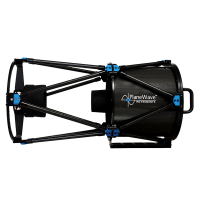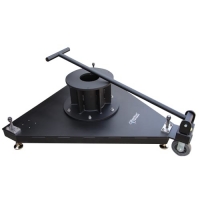
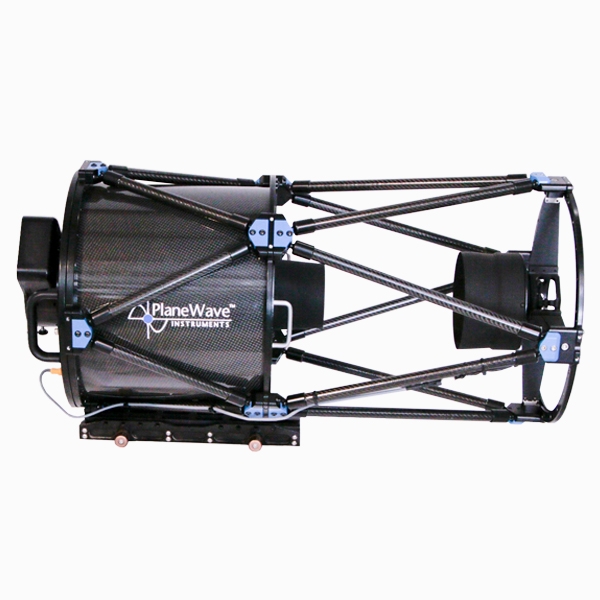
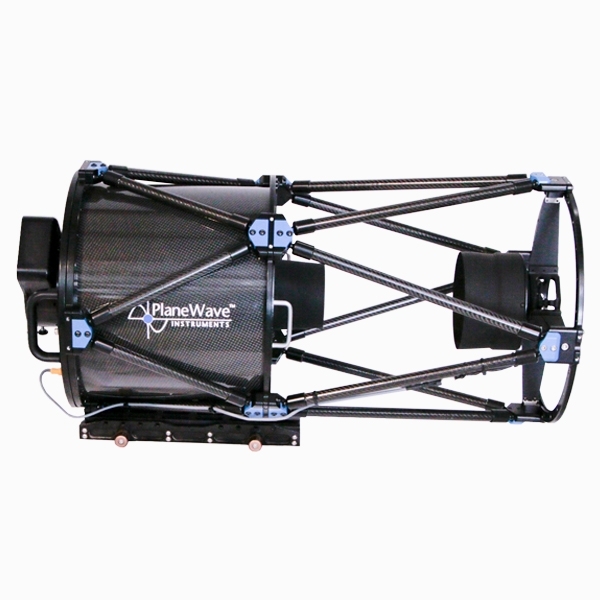
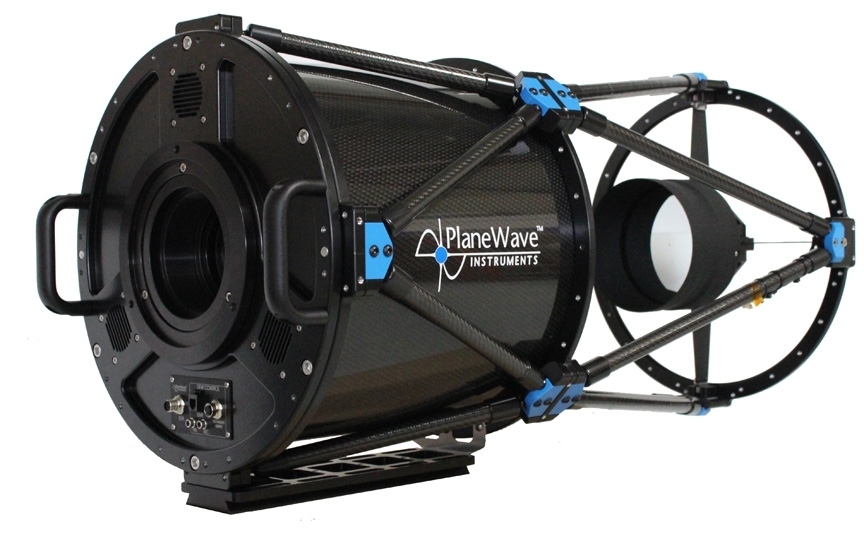
PlaneWave CDK14 Telescope
Price as Configured: $18,500.00
The PlaneWave CDK14 delivers observatory-class imaging in a 48-pound package — pinpoint stars across a 70mm flat field with fused silica optics that hold focus all night. Deep Space Products provides expert guidance on mount selection, imaging train configuration, and complete system integration for both backyard observatories and remote installations. The CDK14 is compatible with DSP Remote hosting under Bortle 1 skies in New Mexico. Contact us to discuss your imaging goals and build the right system.

Tell us what you're looking for, and we’ll point you in the right direction. Email Us.
Frequently asked questions about the PlaneWave CDK14
What mount do I need for the PlaneWave CDK14?
The CDK14 weighs 48 lbs (22 kg) without accessories. For imaging, you'll want a mount with at least 60–80 lbs of rated payload capacity to ensure stability during long exposures. Popular choices include the PlaneWave L-350 (designed for this telescope), 10Micron GM1000HPS EP or GM2000HPS, Astro-Physics 1100 or 1600, and Software Bisque Paramount MX+. Deep Space Products can help you select the right mount based on your imaging goals, portability requirements, and budget.
How does the CDK14 compare to a Ritchey-Chrétien telescope?
The CDK (Corrected Dall-Kirkham) design outperforms most RC telescopes in two important ways: it eliminates off-axis astigmatism and field curvature that RCs still exhibit, and it's dramatically easier to collimate. RC telescopes require precise alignment of a hyperbolic secondary to the primary's optical axis — tolerances are tight and unforgiving. The CDK14's spherical secondary has no optical axis to align, making collimation a simple tip/tilt adjustment that takes minutes. The result is pinpoint stars across your entire sensor without the frustration many RC owners experience.
Does the CDK14 hold focus throughout the night?
Yes — the fused silica mirrors have an extremely low thermal expansion coefficient, and the carbon fiber truss construction minimizes focus shift as temperatures change. Most users report focusing once after the telescope reaches thermal equilibrium (typically an hour after sunset) and imaging all night without refocusing. The three cooling fans accelerate equilibrium, and the optional Delta-T controller provides active dew prevention in humid conditions.
What focuser should I use with the CDK14?
The CDK14 ships without a focuser, giving you flexibility to match your imaging train. PlaneWave offers two options: the Hedrick focuser (a heavy-duty motorized focuser with 20 lb payload capacity and 30mm travel) and the IRF90 Integrated Rotating Focuser (adds 365° rotation for framing). Third-party focusers like the Optec Gemini are also popular. Deep Space Products can recommend the best option based on your camera, filter wheel, and automation requirements.
Can I use the CDK14 with a full-frame camera?
Absolutely. The CDK14's 70mm illuminated image circle easily covers full-frame sensors (43mm diagonal) with excellent correction. Independent testing shows only 10% vignetting in the extreme corners — easily corrected in flat-field calibration. RMS spot sizes remain under 6 microns at 35mm off-axis, meaning stars stay pinpoint across the entire frame even with modern small-pixel CMOS sensors.
Is there a focal reducer available for the CDK14?
Yes. PlaneWave's 0.66x focal reducer converts the CDK14 from f/7.2 to f/4.76, reducing the focal length to approximately 1,690mm. This is useful for widefield targets like large emission nebulae or for faster narrowband imaging. The reducer produces a 30mm illuminated field with excellent star shapes across APS-C sensors and the central portion of full-frame sensors. Some users configure their CDK14 to switch between native f/7.2 for high-resolution targets and reduced f/4.76 for wider fields.
Does Deep Space Products service PlaneWave telescopes?
Deep Space Products is an authorized PlaneWave dealer with extensive experience integrating CDK telescopes into complete imaging systems. While major optical service returns to PlaneWave, we provide consultation on configuration, troubleshooting, and system optimization. We also offer complete observatory integration services — from mount selection through automation setup — and can host your CDK14 at DSP Remote, our Bortle 1 facility in southwest New Mexico.
What's the difference between the CDK14 and CDK12.5?
The CDK14 offers 12% more theoretical resolution and 21% more light-gathering power than the CDK12.5, while both have similar focal lengths (2563mm vs. 2541mm). The CDK14 uses an open carbon fiber truss design (lighter per inch of aperture) while the CDK12.5 has a solid tube. The CDK14's 70mm image circle is also larger than the CDK12.5's, providing better coverage for large-format sensors. If you're deciding between them, the CDK14 is typically the better choice unless weight or budget constraints favor the smaller instrument.
Related Products
 PlaneWave IRF90 - Integrated Rotating FocuserPW-600180 $5,980.00
 PlaneWave Hedrick FocuserPW-200340 $1,325.00