
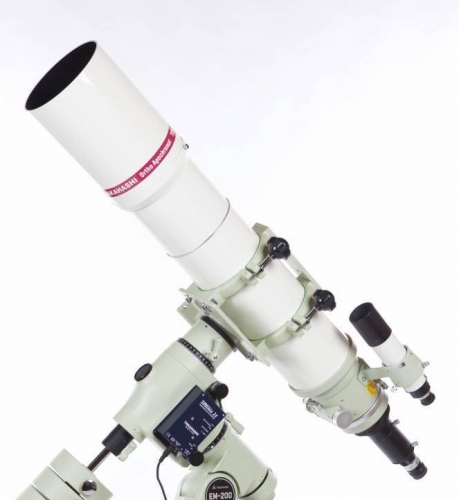
Takahashi TOA-130NFB Refractor
Price as Configured: $6,760.00

Tell us what you're looking for, and we’ll point you in the right direction. Email Us.
Takahashi TOA-130NFB — The Ortho-Apochromat Standard for Serious Astrophotography
The Takahashi TOA-130NFB is a 130mm f/7.7 apochromatic refractor built around Takahashi's proprietary Ortho-Apochromat optical design — a dual FPL-53 ED triplet that reduces the focal shift across the entire visible spectrum to less than ±0.01mm, or roughly 1/100th the residual aberration of a typical apochromatic design. Available from Deep Space Products, the TOA-130NFB is a compelling choice for advanced astrophotographers and visual observers who want refractor-class sharpness, contrast, and color fidelity without compromise.
Refractors earn their reputation by offering something other optical designs can't fully replicate: a sealed, permanently collimated system with no central obstruction, exceptional contrast on fine detail, and color rendering that stays true to the sky. Within the refractor category, the difference between a good apochromat and a great one shows up in exactly the conditions that matter — tight binary stars, planetary detail, and the faint outer arms of galaxies where contrast is everything. The TOA-130NFB was designed to sit at the top of that performance curve.
What "ortho-apochromat" actually means for your images
Most ED triplet refractors achieve excellent chromatic correction by reducing axial chromatic aberration — but this is often accomplished at the cost of residual spherical aberration at different wavelengths, a phenomenon called spherochromatism. Takahashi's TOA design takes a different approach: both the front and rear elements use FPL-53 extra-low dispersion glass (most triplets use only one ED element), and the air-spaced cell geometry is engineered to eliminate spherical aberration entirely across the 436–656nm visible range.
The practical result is an independently measured Strehl ratio of approximately 0.992 — essentially diffraction-limited performance. Stars at the edge of your full-frame sensor remain tight, planetary detail resolves at the theoretical limit of 0.89 arcseconds, and narrowband data integrates cleanly without the subtle halo artifacts that less-corrected designs can introduce. The air-spaced construction also means no oil between elements to degrade or leak over time, and the lens cells can be collimated if ever needed.
A focuser built for demanding imaging rigs
The "NFB" designation distinguishes this model from the TOA-130NS: where the NS carries a 2.7" rack-and-pinion focuser suited to visual and lighter imaging use, the NFB ships with a 4" dual-speed rack-and-pinion focuser with 7:1 fine-focus reduction and a built-in 360° camera angle adjuster (CAA). The focuser provides approximately 274.5mm of back focus — enough to stack a filter wheel, electronic focuser, off-axis guider, and large-format camera without running out of travel. Users who have pushed the focuser with heavy setups consistently report it holds position reliably; Takahashi specifically redesigned the 4" focuser for the current NFB to handle payloads that earlier versions struggled with.
For imaging circles, the TOA-130NFB delivers a 70mm fully illuminated field natively. Add the optional 67-series flattener and you get a 90mm imaging circle with pinpoint stars across a 5.3° field — coverage that exceeds the sensor diagonal of most full-frame cameras. A focal reducer is also available for those who want shorter exposures at the cost of some field scale.
Building a complete TOA-130 system
One thing to know before ordering: the TOA-130NFB ships as an optical tube assembly only. Tube rings (or the Takahashi tube holder for EM-200 and larger mounts), a hard case, and a finderscope are all sold separately and add meaningfully to the total cost. This is worth budgeting for upfront. The 155mm tube OD means you'll want rings sized appropriately — Takahashi's own cradle system (TKA31420) or third-party split rings are the two common paths.
On the mount side, the OTA weighs approximately 22–27 lbs depending on configuration. Add a camera, filter wheel, and guide system and you're looking at a realistic imaging payload of 15–20 lbs. A mount with at least 30–40 lbs of rated payload capacity gives you the working margin that long-exposure astrophotography demands. Deep Space Products can help you evaluate mount options based on your target focal lengths, imaging cadence, and whether you're building a portable or permanent system.
Is the TOA-130NFB the right refractor for you?
The TOA-130NFB is a compelling choice if you're imaging with a full-frame or APS-C sensor and want a refractor that will perform to the edge of the frame without apology. It's particularly well suited to solar system imaging, high-resolution deep sky work, and any application where color accuracy and contrast matter. At f/7.7, exposure times are longer than a faster design — if you're chasing very faint extended nebulosity and session time is limited, a faster optical system may suit you better. But for the quality of the result, few refractors at any price produce images with this level of optical purity.
The TOA-130NFB is also an excellent candidate for a permanent or remotely hosted setup, where its long-term stability, consistent performance, and sealed optical design become especially valuable over time.
Talk through your TOA-130 system with Deep Space Products
Deep Space Products carries the full Takahashi accessory ecosystem — flatteners, reducers, extenders, mounting hardware, and compatible eyepieces — and can help you configure the right combination for your camera, sensor size, and imaging goals. We also operate DSP Remote, a Bortle 1 telescope hosting facility in southwest New Mexico, where the TOA-130NFB is a natural fit for a permanent imaging rig. Contact us to talk through your system before you order.

