
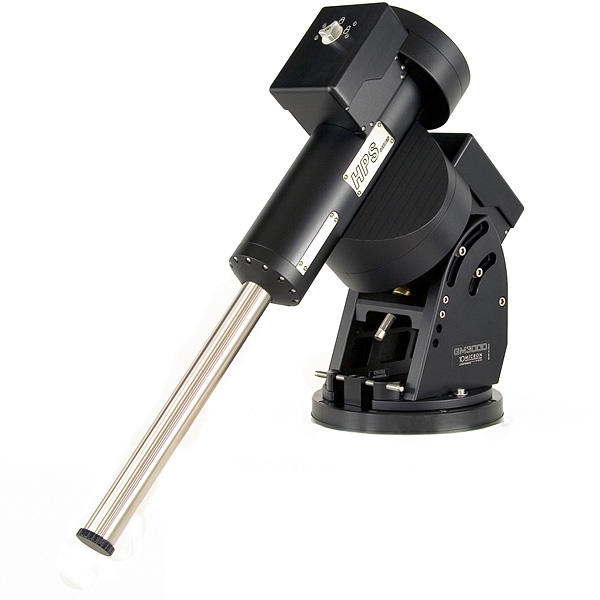
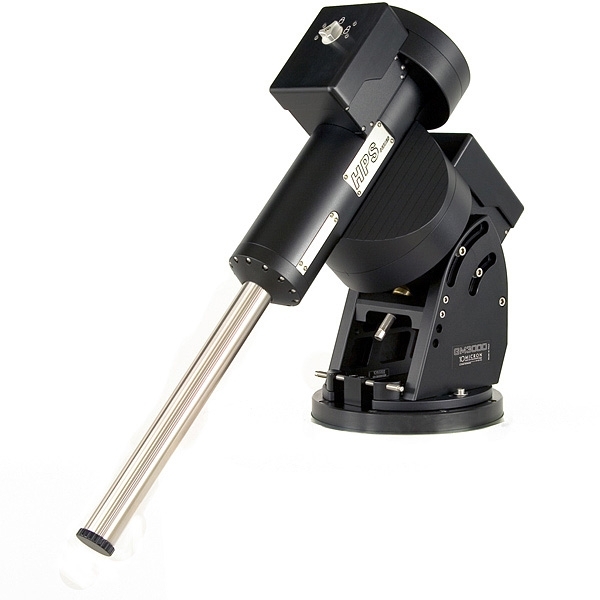
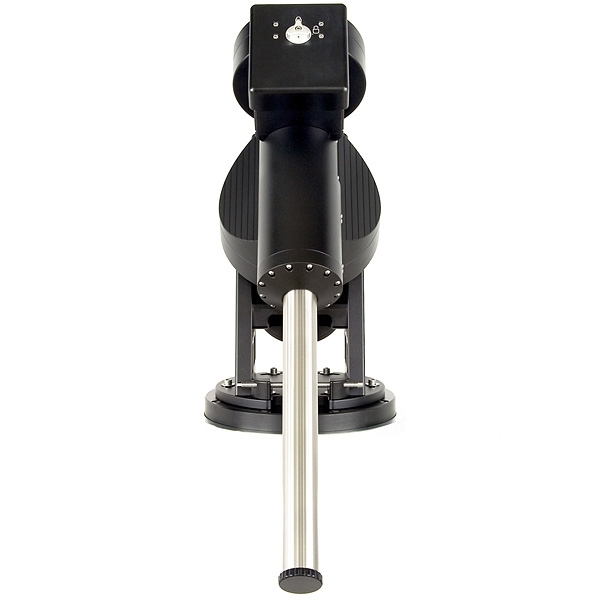
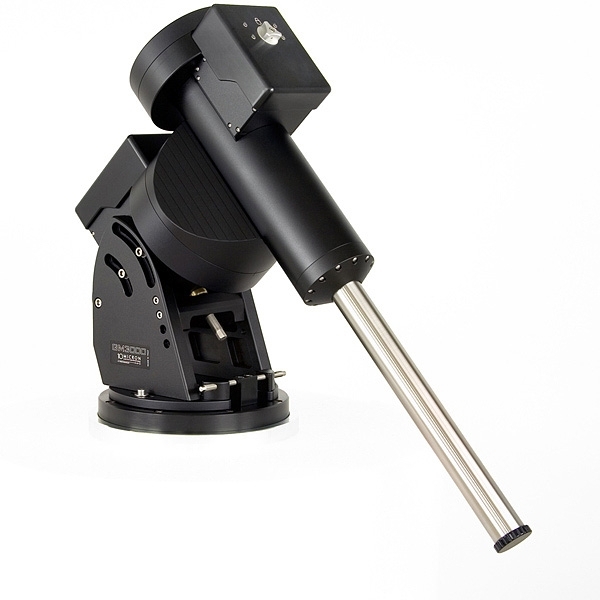
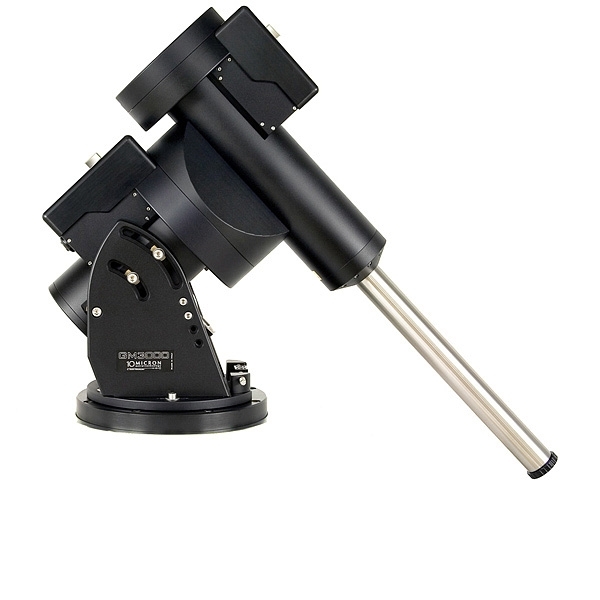
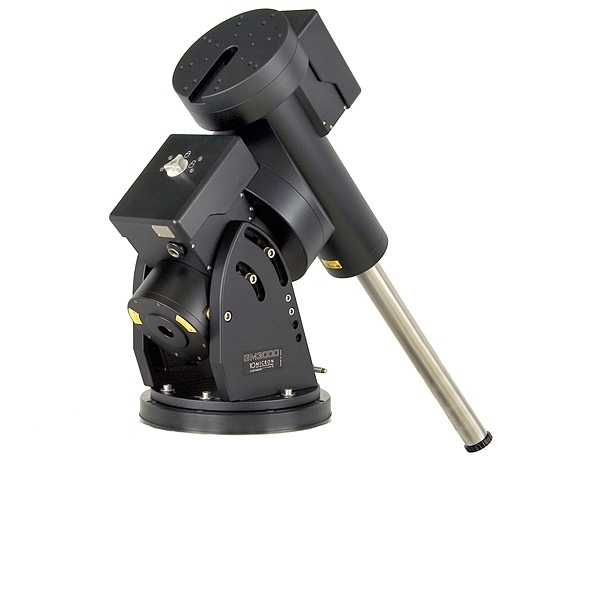
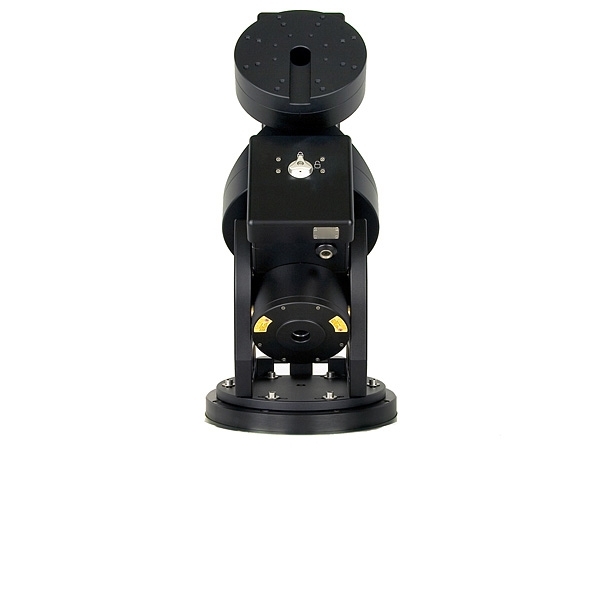
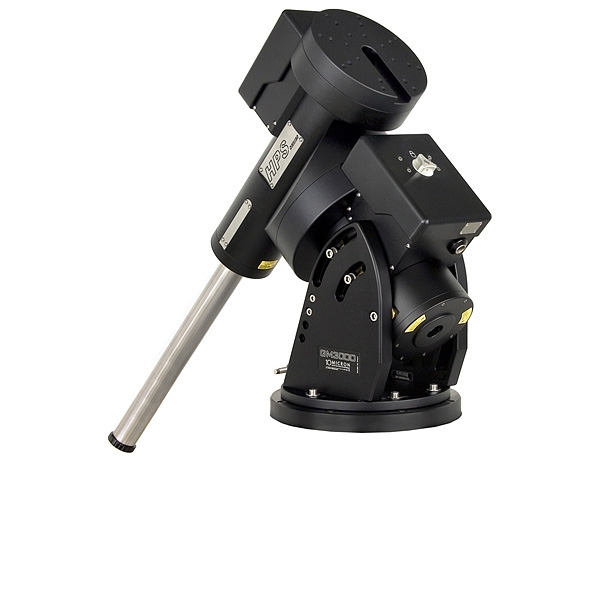

10Micron GM3000HPS Equatorial Mount
Price as Configured: $20,999.00

Tell us what you're looking for, and we’ll point you in the right direction. Email Us.
10Micron GM3000HPS — Observatory-Grade Tracking for Large-Aperture Instruments
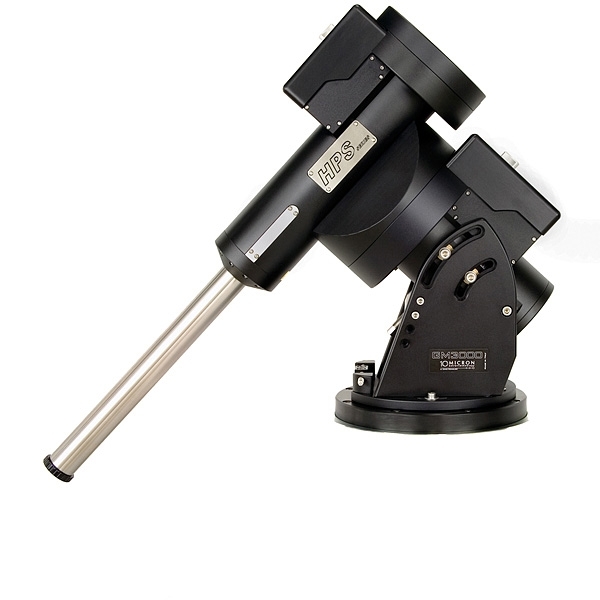
The 10Micron GM3000HPS is a 220 lb capacity German equatorial mount built in Italy by 10Micron, designed for permanent observatory installations housing large-aperture telescopes — from 180mm apochromatic refractors to 17-inch Cassegrain astrographs. Available from Deep Space Products with exclusive U.S. certified service and support, the GM3000HPS features absolute encoders on both axes as a standard component, a standalone Linux-based controller that operates without any external PC, and internal cable routing through both the RA and Dec axes — a feature that separates observatory-tier mounts from field mounts and makes the GM3000HPS purpose-built for long-term automated operation. For advanced astrophotographers and observatory builders who need a mount that will reliably carry large instruments through hours of unattended imaging, the GM3000HPS is one of the most capable worm-drive platforms in its class.
A step up in precision — by design
When you move from the GM2000HPS II Combi to the GM3000HPS, everything scales up in ways that matter mechanically. The RA axis grows to 3.1 in (80 mm) diameter alloy steel. The B14 bronze worm wheel in right ascension reaches 9.6 in (244 mm) in diameter with 315 teeth — machined to tolerances that reflect 10Micron's roots in the European precision machine tool industry. The counterweight shaft steps up to 2.0 in (50 mm) diameter, matched to the 44 lb (20 kg) counterweights the GM3000 requires.
The result is a mount that carries 220 lbs dynamically — slewing at up to 12°/sec in declination and tracking at better than 0.7 arcsecond RMS with a well-constructed pointing model. Users running PlaneWave CDK17 astrographs and 16-inch Ritchey-Chrétiens on GM3000 installations report smooth, unguided sessions at focal lengths where less capable mounts require continuous guide corrections.
The observatory feature the GM2000 doesn't have: internal cable routing
One of the most practically significant differences between the GM2000HPS II Combi and the GM3000HPS doesn't appear in the headline specs: internal cable routing through both axes. The GM3000's RA and declination axes are bored to allow instrumentation cables — power, USB, camera control, focuser, filter wheel — to pass cleanly through the mount head itself, emerging near the payload saddle.
In a remote or automated observatory, this is not a luxury. It's the difference between a system that runs reliably for months without intervention and one that eventually tangles, snags, or develops intermittent electrical issues as cables flex against moving parts. The GM2000, designed to serve double duty as a field mount, does not offer this. If internal cable routing is on your observatory checklist, the GM3000HPS is where you find it in the 10Micron line.
Tracking, pointing, and the case for skipping autoguiding
The GM3000HPS uses the same absolute encoder architecture as every 10Micron HPS mount. Absolute encoders integrated directly into each axis — not added as a retrofit — mean the mount always knows precisely where it is pointing, independent of motor counts. Unlock the clutches, move the mount by hand, lose power during a session: the mount resumes where it left off without a new alignment sequence.
Build a pointing model using the mount's own firmware (no external PC required), and the GM3000 compensates in real time for periodic error, atmospheric refraction, polar alignment offsets, and optical tube flexure. Tracking accuracy reaches below 0.7 arcseconds RMS with a 25-star model, and the mount's 100-point model capability pushes pointing accuracy to under 20 arcseconds across the sky — high enough that experienced users routinely image without autoguiding even at focal lengths exceeding 2,000mm.
The mount supports ±30° of meridian tracking past the meridian in both directions (configurable in firmware), giving any object at least four hours of continuous uninterrupted coverage — a critical capability for automated imaging sequences running overnight without a human present.
Remote and automated operation — the mount is the computer
The GM3000HPS's standalone Linux-based controller handles everything the mount needs to operate: pointing model calculation, multi-object tracking (including comets, asteroids, and satellites from user-loaded orbital elements), dome rotation control via RS-232, and power management through a dedicated relay connector. Connect via Ethernet or WiFi from anywhere on your network and control through ASCOM, the LX200/Meade protocol, or the AP GTO command set — compatible with NINA, Voyager, MaximDL, TheSkyX, Sequence Generator Pro, and every major observatory automation platform. The mount needs no external PC to execute a full night's imaging run.
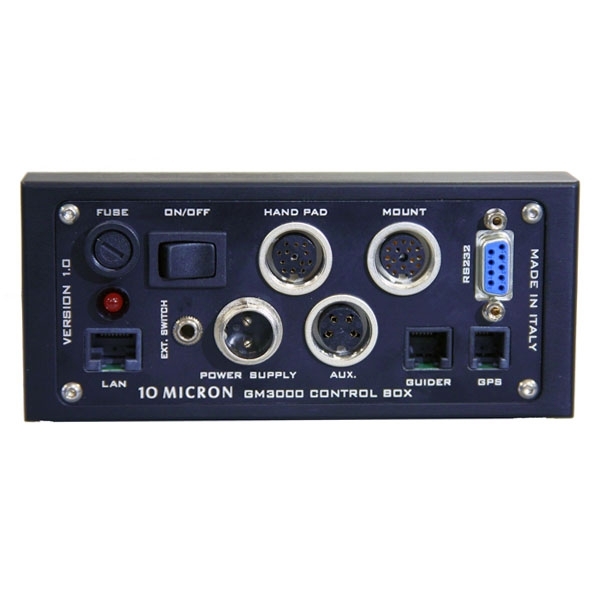
The current Controlbox V3 adds an ARM-based processor, Binder industrial-grade connectors rated for moisture, dust, and temperature extremes, a dedicated external WiFi antenna port, and updated GPS integration with a PPS signal for precise timekeeping. The Binder connector system in particular is a meaningful improvement in long-term remote observatory reliability. Deep Space Products operates DSP Remote, a Bortle 1 hosting facility in southwest New Mexico, where the GM3000HPS is among the most commonly installed observatory mounts.
How the GM3000HPS compares to other premium mounts
Astro-Physics 1600GTO: At the same 220 lb payload rating, the AP 1600GTO is the most natural comparison point at this tier. The 1600GTO splits into two pieces — approximately 57 lbs and 40 lbs — making it lighter to handle than the GM3000's 143 lb head, which matters for any installation that requires moving the mount. However, the GM3000HPS is designed as an observatory mount only. Astro-Physics offers an optional Renishaw absolute encoder upgrade for the 1600GTO; the GM3000HPS includes absolute encoders as a standard, integrated component. The AP uses APCC/APPM as its pointing model platform — software with a devoted following — while the GM3000HPS's pointing model lives in the mount's own firmware and is accessible through any ASCOM-compatible software without committing to a specific platform. Three different freeware modeling programs are currently in use by customers around the world. New AP 1600GTO units have historically been subject to extended wait times; the GM3000HPS is available for order from Deep Space Products, with U.S. service handled exclusively by DSP.
Paramount ME II (Software Bisque): The ME II and newer ME Series 6 carry a slightly higher stated payload of 240 lbs and a lighter head at approximately 85 lbs. On-axis encoders are not included at the base price — adding dual encoders represents at least $6,000 additional cost. The ME II and ME Series 6 integrate deeply with Software Bisque's TPoint and TheSkyX platform, which is good software for users already invested in that workflow. The GM3000HPS's standalone controller and ASCOM-native approach leaves you free to choose your own automation platform.
PlaneWave L-series (direct drive): The PlaneWave L-350 and L-500, both available from Deep Space Products, take a fundamentally different approach — direct drive motors with no worm gear, and therefore no periodic error by design. For a single-telescope permanent installation where simplicity and minimal maintenance are the priorities, the L-series is worth considering alongside the GM3000HPS. However, the GM3000HPS's German equatorial design is typically better suited to dual OTA side-by-side configurations and instruments that benefit from counterweight balancing across a wide payload range. The GM3000HPS is significantly easier to install and set up then the L-Series mounts.
If you'd like help thinking through which mount fits your specific instrument, pier, and automation setup, contact Deep Space Products — we've helped configure all of these systems.
ColdTemp and factory-order options
A ColdTemp upgrade (item #10M-3000F) is available for installations in sustained extreme cold — rated to -22°F (-30°C) operation, with greases certified to well below that and internal components rated for storage to -40°F (-40°C). This is the right choice for high-altitude sites, northern-latitude observatories, or locations where temperatures regularly sustain well below freezing. Most North American installations do not require it.
This upgrade must be specified at the time of order. It is integrated during factory assembly and cannot be retrofitted after delivery. Contact Deep Space Products before placing your order if you're unsure whether your site warrants it.
What's in the package
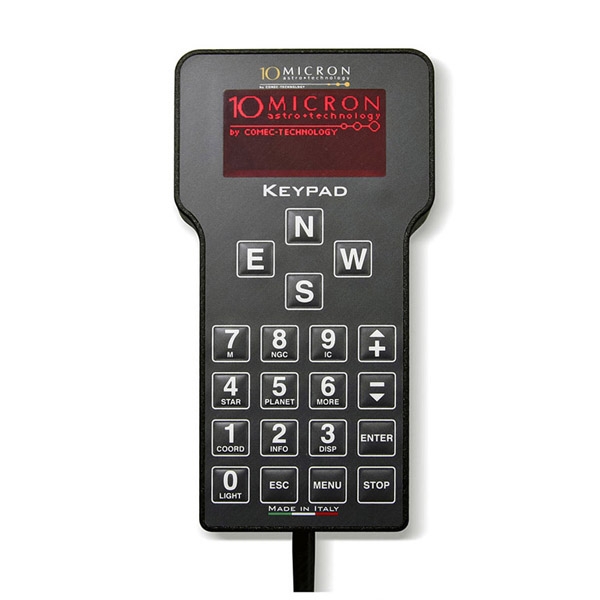
The GM3000HPS standard package includes the mount head with absolute encoders on both axes, Controlbox V3 with standalone Linux controller, professional hand control with graphic display and red backlight for cold-weather use, counterweight shaft, all required cables, and integrated WiFi.
Mandatory shipping kit: A wooden pallet-box with the steel pier adapter flange (item #10M-3090) are required by 10Micron for all GM3000 orders due to the mount's size and weight. This kit (item #10M-3199) appears as a required selection at checkout. The pier adapter is not just for shipping — you will need it for pier installation.
Counterweights are not included in the standard package. The GM3000-specific 44 lb (20 kg) counterweight (item #10M-3083, $590) is available as an add-on and uses a 50mm bore matched to the GM3000 counterweight shaft.
Talk to Deep Space Products before you configure
As the exclusive certified U.S. service provider for 10Micron, Deep Space Products doesn't just sell the GM3000HPS — we service it, support it, and help you build the complete observatory system around it. Whether you're housing a CDK14 or CDK17, building a dual OTA side-by-side setup, or integrating into an institutional dome, the DSP team can walk through your instrument load, pier configuration, automation platform, and imaging goals before you place your order.

