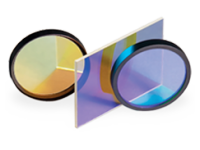
Chroma Technology SII Ha OIII - 3nm Filter Set
Price as Configured: $1,675.00
Deep Space Products carries the full range of Chroma filter sizes to match your camera and filter wheel. Contact us to discuss which configuration fits your imaging train.

Tell us what you're looking for, and we’ll point you in the right direction. Email Us.
Chroma HA3LRGB Filter Set — Precision Narrowband and Broadband Imaging in One Package
The Chroma Technology HA3LRGB filter set combines a high-transmission 3nm hydrogen-alpha narrowband filter with a matched LRGB broadband set, giving astrophotographers the tools to capture both emission nebulae and traditional deep-sky targets with a single filter collection. Manufactured in Vermont by Chroma Technology — an employee-owned company with over 30 years of optical filter expertise — this set delivers the spectral precision and coating durability that serious imagers demand. Deep Space Products is an authorized Chroma dealer, offering the full range of filter sizes to match your imaging system.
For astrophotographers who split their time between narrowband nebula work and broadband galaxy or cluster imaging, the HA3LRGB set eliminates the need to purchase separate filter collections. The 3nm H-alpha filter isolates the 656.3nm hydrogen emission line with exceptional precision, while the LRGB filters capture accurate color data for everything from spiral galaxies to globular clusters.
Why choose a 3nm H-alpha filter?
The bandwidth of your H-alpha filter directly affects contrast and sky background rejection. Chroma offers 3nm, 5nm, and 8nm options — and the choice matters more than many imagers realize.
A 3nm bandwidth provides maximum contrast by blocking nearly all light outside the narrow hydrogen-alpha emission line. This translates to darker backgrounds, better signal-to-noise ratio, and more defined nebula structure — especially valuable when imaging from Bortle 5+ skies or during moonlit nights. The tradeoff is longer required exposure times compared to wider bandwidths, since less total light reaches the sensor.
For portable setups or shorter imaging sessions, a 5nm or 8nm H-alpha filter may be more practical. But for observatory-based imaging, remote hosting setups, or anyone prioritizing maximum nebula detail over integration speed, the 3nm filter delivers results that wider filters cannot match.
Chroma's coating and construction advantage
Chroma filters are built differently than most competitors. The company coats large 8-inch sheets of optical glass using reactive magnetron sputtering, then cuts filters to size — ensuring even coating thickness all the way to the edge. This matters because filters cut before coating often have thinner coatings at the edges where the substrate rested on supports during the coating process.
Key construction features include:
- 3mm single-substrate glass — no laminations that can degrade over time
- Hard sputtered front coating — resists humidity and temperature extremes without spectral drift
- Anti-reflection rear coating — prevents ghosting and maximizes light transmission
- Parfocal design — swap filters without refocusing
- 7mm cell height (mounted versions) — fits virtually all filter wheels and drawers
Chroma filters maintain spectral accuracy across temperature swings that would shift the passband of lesser filters. For remote observatory use or imaging in variable conditions, this stability is essential.
How does Chroma compare to Astrodon and other premium filters?
Astrophotographers frequently compare Chroma to Astrodon, the longtime benchmark for premium imaging filters. Based on extensive community testing and user reports, Chroma filters deliver equivalent optical quality at a lower price point — often $500–700 less for a complete 50mm filter set.
Users transitioning from Baader filters often report that Chroma eliminates the halo and reflection artifacts that can affect Baader narrowband filters with certain camera/telescope combinations. While Baader offers good value at a lower price tier, the Chroma coating technology provides cleaner performance for demanding imaging setups.
For imagers who already own Astrodon filters and are considering mixing brands: note that Chroma's 3mm substrate matches Astrodon's thickness, but the two brands are not perfectly parfocal. Minor focus adjustments may be needed when switching between them.
What's included in the HA3LRGB set
The Chroma HA3LRGB set (CT-Ha3LRGB / 27109) includes five filters:
- H-alpha 3nm — Peak transmission at 656.3nm, >95% transmission at peak wavelength
- Luminance (L) — Full visible spectrum for maximum signal collection
- Red (R) — Broadband red channel for color imaging
- Green (G) — Broadband green channel for color imaging
- Blue (B) — Broadband blue channel for color imaging
All filters share the same 3mm substrate thickness and are parfocal within the set. Available sizes include 1.25" mounted, 2" mounted (M48×0.75 thread), 31mm unmounted, 36mm unmounted, 50mm round unmounted, and 50×50mm square unmounted.
Choosing the right filter size
Filter size selection depends on your camera sensor and optical system. The filter must be large enough to avoid vignetting at your imaging circle:
- 1.25" mounted (26.5mm clear aperture) — Suitable for smaller sensors up to approximately APS-C size with slower optical systems
- 31mm unmounted — Common for filter wheels designed for medium-format sensors
- 36mm unmounted — Fits many standard filter wheels including those from ZWO and QHY
- 2" mounted / 50mm round — Required for full-frame sensors and fast optical systems
- 50×50mm square — For large-format filter wheels and custom imaging trains
If you're unsure which size fits your imaging train, contact Deep Space Products — we can help you determine the right configuration based on your camera, filter wheel, and optical system.
Discuss your filter setup with Deep Space Products
Selecting the right filters involves matching bandwidth, size, and coating characteristics to your specific imaging goals and equipment. Deep Space Products carries the complete Chroma filter line and can help you evaluate options based on your camera, optical system, and target types. Reach out to discuss your setup — we're here to help you build an imaging system that performs.

